
Pool Heater Not Working? Error Codes & What to Check
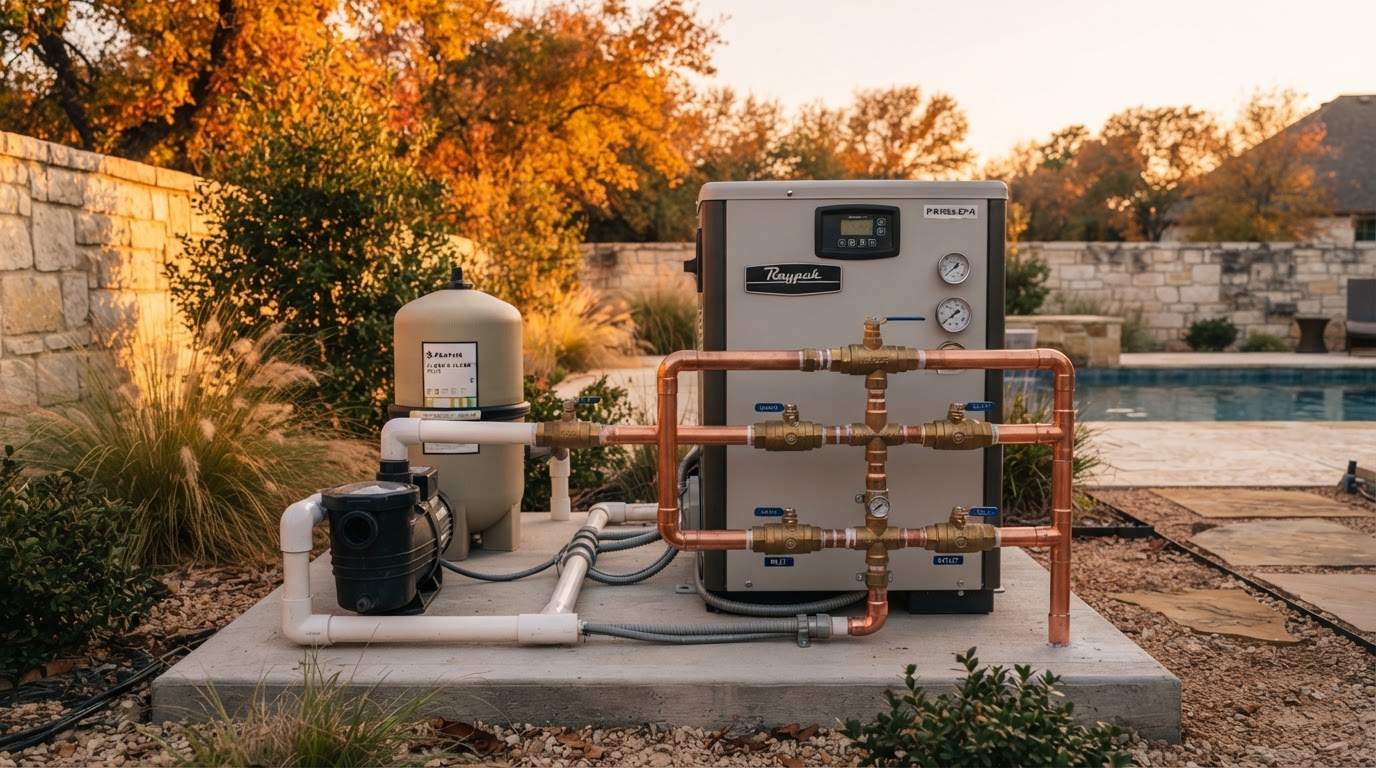
Pool heater won't fire or showing an error code? What each code family means, what you can safely check, and the one thing most owners never look for — rodent damage.
Your pool heater either will not fire or is showing a code on the display, and it is probably the first time you have asked it to work in months. Here is what each symptom most likely means, what you can safely check from outside the cabinet, and where the line is between a reset and a licensed repair.
Heater won't turn on at all or the display is blank
The most likely cause is no power to the control board — a tripped breaker, a blown fuse in the heater, or a disconnected power supply. Check your breaker box first. If the pool equipment breaker has tripped, flip it off and back on.
What else it could be: a failed transformer inside the heater, a loose wire connection at the control board, or a faulty power switch on the unit.
What you can safely check: the breaker position, whether the heater's power switch is on, and whether the display has any backlight or activity at all. If the display is completely dark with the breaker on, the control board may not be receiving power.
When to stop: if the breaker trips again immediately after resetting, do not keep resetting it. A repeated trip means something is shorting, and that is electrical work. In Texas, electrical work on pool equipment is licensed work — No Worries Pool Care holds TDLR RAIC #214, verifiable at tdlr.texas.gov.
Heater tries to light but won't fire
The heater clicks, you hear the igniter or spark, but the burner does not establish a flame. The most common cause is a dirty or failed flame sensor — the rod that confirms the burner lit. If it cannot sense the flame, the heater shuts the gas valve as a safety measure.
What else it could be: low gas pressure, a faulty gas valve, a blocked or corroded burner tray, or a bad igniter.
What you can safely check: confirm the gas valve at the heater is in the open position. Check that nothing is blocking the exhaust vent or the air intake. If the heater sits outside, confirm no debris has piled against the cabinet vents.
When to stop: do not attempt to clean or replace the flame sensor yourself. It sits inside the burner compartment near open gas. A flame sensor is a common, repairable failure — it does not mean you need a new heater. Call for pool equipment repair.
Heater fires, then shuts off after a minute or two
A heater that lights and runs briefly before shutting down is almost always tripping on a safety switch — most commonly the high-limit switch or the water pressure switch. The high-limit switch cuts power when the water inside the heat exchanger gets too hot, and the pressure switch cuts power when water flow through the heater is too low.
What else it could be: poor water flow from a dirty filter or closed bypass valve, a faulty high-limit sensor, or scale buildup inside the heat exchanger restricting flow.
What you can safely check: check your filter pressure — if it reads 8 to 10 PSI above its clean baseline, the filter needs cleaning, and low flow is your cause. Confirm the heater bypass valve is in the correct position (it should be partially closed to force water through the heater, not fully open). Check that the pump is running and the water level is at the midpoint of the skimmer.
When to stop: if the heater keeps tripping after the filter is clean and the bypass is set correctly, the high-limit or pressure switch may be faulty, or the heat exchanger may be scaled. Repeatedly resetting a heater that keeps tripping a high limit is not fixing it — the safety device is doing its job. Call for diagnosis.
Heater runs but the water isn't getting warmer
The heater fires and runs, but the pool temperature does not climb. The most common cause is a thermostat set too low or a bypass valve fully open, so most of the water skips the heater entirely.
What else it could be: a scaled heat exchanger that transfers heat poorly, a heater that is undersized for the pool volume, or a damaged bypass valve that is stuck open internally.
What you can safely check: confirm the thermostat is set above the current water temperature. Check the bypass valve position. Check that the pump is running long enough hours — a heater cannot warm water that is not circulating through it.
When to stop: if the bypass and thermostat are correct and the heater runs continuously without raising the temperature, the heat exchanger may be scaled. North Texas water is hard, and mineral scale builds up inside heat exchanger tubes over years, restricting flow and insulating the heat transfer surface. That needs diagnosis. Call for service.
Heater is making a rumbling or banging noise
A low rumble or banging sound from inside the heater is usually one of two things: scale rattling inside the heat exchanger as water forces past it, or delayed ignition — gas pooling in the burner tray and igniting all at once with a thump.
What else it could be: a cracked heat exchanger, or a burner tray with debris or a partially blocked orifice.
What you can safely check: nothing inside the cabinet. Listen from outside and note whether the sound happens at ignition or while the heater is running steadily.
When to stop: both causes require opening the burner compartment. Delayed ignition is a gas safety issue — gas is accumulating before it lights. A rumbling heat exchanger with scale means the tubes are narrowing and flow is restricted. Turn the heater off and call for service. This is the kind of problem that develops slowly during the months a heater sits idle — our Pool Watch maintenance program inspects heaters as part of the quarterly equipment check, before the first cold night forces the issue.
Water is leaking from the heater
Water from under or inside the heater cabinet is most often a failed heat exchanger. The heat exchanger is the component where water passes through tubes heated by the burner, and it is the single most expensive part in the unit. Cracks or pinhole leaks develop from age, freeze damage, or scale corrosion.
What else it could be: a leaking bypass valve, a loose plumbing connection at the inlet or outlet, or condensation on a cold morning that is not actually a leak.
What you can safely check: look at where the water is coming from. If it is from the inlet or outlet plumbing connections, that may be a loose fitting. If it is from inside the cabinet or dripping from the bottom of the heat exchanger, that is the exchanger itself.
When to stop: a leaking heat exchanger is not a DIY repair. If the heater cracked after a freeze, it is worth reading our guide on how to prepare your pool for a Texas freeze before the next one. A heat exchanger is a replaceable component, but it is a major repair — call for diagnosis before assuming the whole heater needs replacing. Our heater repair service diagnoses Raypak, Jandy, Pentair and Hayward units and quotes the exchanger separately from the labor, so you can decide whether a replacement part or a new heater makes more sense.
Heater is showing a code I don't recognise
A code on the display is the heater's control board telling you it shut down for a specific reason. The code identifies a family of fault, not always a single component. Codes vary by brand, by model, and across generations of the same model, so the only authoritative source is the manual for your exact unit.
What you can safely check: write the code down, note whether it appeared at ignition or during running, and note whether it repeats after a reset.
When to stop: a code is the heater refusing to run for a reason. If the same code returns after a reset, the safety device is doing its job. Repeatedly resetting is not a fix. Call for pool equipment repair and give us the code.
Error codes by brand
Heater error codes fall into a handful of families regardless of manufacturer. Here is what each family protects against, what commonly causes it, and whether a reset is reasonable or a warning sign. For your exact code, confirm against the manufacturer's current manual — codes differ by model and generation.
Pentair
Pentair MasterTemp and UltraTemp heaters use a two-digit or three-letter code system. Common fault families: ignition and flame-sense faults (the heater tried to light and could not confirm the flame), high-limit trips (water inside the exchanger got too hot), water pressure and flow faults (the pressure switch detected inadequate flow), and stack or flue sensor faults (the exhaust temperature sensor read out of range). A single ignition fault after months of idle is often a dirty flame sensor and a reset is reasonable. A high-limit or flow fault that returns after a reset is a warning sign — the safety device is responding to a real condition. Confirm your code at Pentair's support site.
Hayward
Hayward heaters (the H-Series and the heat pump line) display codes on the digital control. Common families: ignition faults, high-limit trips, pressure switch faults, and internal control or sensor failures. Hayward's flow and pressure faults are frequently caused by a dirty filter or a closed bypass, and clearing those may clear the code. A persistent ignition fault after a reset usually points to the flame sensor or gas supply. Confirm your code at Hayward's support site.
Raypak
Raypak heaters (the Versa and ASME lines) use a control board with a digital display. Common families: ignition and flame-rectification faults, high-limit trips, water pressure switch faults, and stack sensor or rollout switch faults. Raypak's rollout switch trips when flame exits the burner tray — a serious combustion problem that should never be reset. A flow or pressure fault after cleaning the filter is reasonable to reset once. Confirm your code at Raypak's support site.
Jandy
Jandy (Zodiac) heaters use the Versa-Plumb control platform. Common families: ignition faults, high-limit trips, water pressure switch faults, and internal control board or sensor failures. Jandy's ignition faults are often flame-sensor related, and a single occurrence after a long idle period is frequently cleared by cleaning the sensor. A recurring high-limit or flow fault is a warning sign. Confirm your code at Jandy's support site.
The thing almost nobody checks: what's living inside your heater
A pool heater cabinet is an ideal nest. It is dry, sheltered, warm, and undisturbed for months at a time. Rats, mice, and squirrels all use them. A heater that sat idle all season and is switched on without being opened and inspected is the scenario that matters most on this page.
The fire risk is the mechanism, not a maybe. Nesting material is dry, fibrous, and combustible, and it accumulates on or near a burner tray that produces open flame. When the heater fires for the first time in months, that material is sitting exactly where the flame goes.
Chewed wiring is the other half. Rodents strip insulation from low-voltage and sensor wiring, which produces intermittent, hard-to-diagnose faults. A heater that throws a different code every week often has a wiring problem, not a component failure — the flame sensor reads fine one day and faults the next because the wire connecting it is half-chewed.
Nests also block airflow and venting, which can cause flame rollout and, where a heater sits in an enclosed equipment room, a carbon monoxide concern.
Signs visible without opening anything: droppings around or under the equipment pad, chewed insulation or wire fragments, shredded nesting material at the base of the cabinet, a distinct smell near the heater, or unexplained intermittent faults that do not match any single code.
Do not open the heater cabinet yourself. Gas and live electrical are both inside. What you can do is look from the outside for the signs above, and know that opening and inspecting the burner tray is part of what a technician does on a service call.
The seasonal reality ties this together. A pump runs daily, so problems announce themselves. A heater sits idle for months and tells you nothing until the night you want to use it — which is precisely when the nest is discovered the wrong way. A heater that worked fine in March may not in November; nothing failed in between, it simply was not being asked to do anything.
Pool heat pumps are a different machine
If you have a pool heat pump rather than a gas heater — a Pentair UltraTemp, Hayward HeatPro, or Jandy heat pump — the content above about gas and combustion does not apply to your unit. Heat pumps use electricity and refrigerant, not a burner. There is no gas valve, no flame sensor, no burner tray, and no rodent fire risk from nesting material near open flame.
Heat pumps have different failure modes: defrost cycles in cold ambient temperatures (a heat pump cannot extract heat from air that is too cold), refrigerant charge issues, fan motor failures, and ambient temperature limits that simply prevent the unit from running efficiently below a threshold. A heat pump that runs but does not warm the water in November may be hitting its ambient limit, not failing. The manufacturers above all publish heat pump manuals alongside their gas heater manuals — confirm your model.
Safety, stated once and firmly
If you can smell gas near the heater: do not operate it, do not touch any electrical switches, leave the area, and call your gas utility. No exceptions and no troubleshooting steps.
Soot, scorching, or black marks around the cabinet mean combustion problems. Stop using the heater.
Repeated high-limit or flow trips mean a safety device is working. Stop resetting it.
Gas and electrical work on pool heaters is licensed work in Texas. No Worries Pool Care holds TDLR RAIC #214, verifiable at tdlr.texas.gov. We service Hayward, Pentair, Raypak, and Jandy equipment.
Most heater faults are repairable
A flame sensor, a pressure switch, a thermostat, or chewed wiring is not a new heater. Most heater problems are component-level repairs. The reason most owners expect to hear "you need a new heater" is the same as with pumps — the person telling them is selling heaters, not repairing them. If your pump is also giving trouble, our companion guide to pool pump symptoms and when to stop covers the same ground for the other half of your equipment pad. Where a heater is beyond economical repair and a high-efficiency replacement genuinely makes sense, our pool equipment upgrade options include modern units that cost less to run. And if a home warranty came with the house, it is worth knowing that a heater replacement is exactly the claim a warranty cap will not cover — the arithmetic in that post uses the heater as its example.
If you want us to look at it
A photo rarely settles a heater. Error codes need meters on the equipment and a look at the wiring, which is what the diagnostic visit is for.
A flat $145 diagnostic fee, credited in full toward any repair we carry out. We diagnose, tell you what we found, and you decide. A pre-season heater inspection before the first cold night is the sensible response to everything above — it is when a nest, a scaled exchanger, or a dirty flame sensor gets found on your schedule, not on the evening you wanted to swim. Phone 469-835-5674, or reach us through our contact page.
Serving Flower Mound, Highland Village, Argyle, Lewisville, Bartonville, Double Oak, Lantana, Northlake and Copper Canyon.